
Homelessness in Norwalk: More people are on the edge, and federal cuts could push more over it
By Ashley Smith - Nancy on Norwalk
Norwalk Homelessness Is Rising — and Federal Cuts Could Make It Worse
NORWALK, Conn. — On paper, Norwalk has made real progress on homelessness in recent years. But the people doing that work say a coming wave of federal funding cuts, combined with rents that keep rising, could erase those gains fast.
Open Doors, the city’s primary homeless services provider, housed 81 people last fiscal year and is on track to house at least 100 by the end of June. The nonprofit runs both a shelter and a street outreach team, which has served 49 people in the last 11 months.
The Housing Collective administers the broader Fairfield County homeless response system, and 211 serves as the front door for people in crisis, connecting callers to housing assistance, food assistance, energy programs, and other resources.
“The only way to solve it is to solve it individually,” said Michele Conderino, chief executive officer of Open Doors, who has worked in homeless services for about 20 years. “You can’t solve something globally if you’re not doing it, person by person.”
The data, and the people closest to it, show the problem is growing faster than it is being solved.
“Seven People Away”
In the summer of 2022, Open Doors came remarkably close to a milestone. The organization was just seven people away from ending unsheltered homelessness in Norwalk entirely.
Then the rental market collapsed any hope of that.
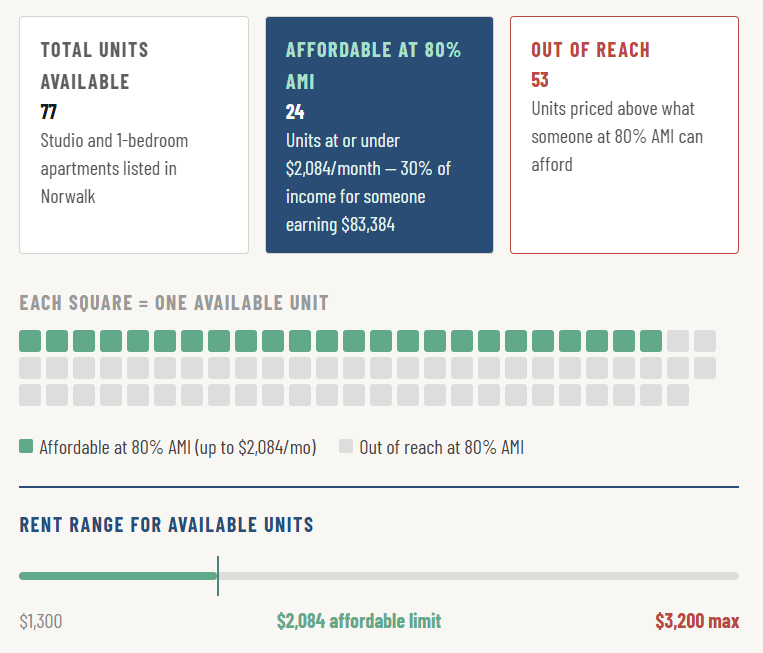
Only 24 of 77 Norwalk apartments are affordable at 80% of median income
For a single adult earning 80% of the area median income ($83,384), federal guidelines say housing should cost no more than $2,084 a month. In Norwalk’s current rental market, that rules out nearly 7 in 10 available units.
Source: Center for Housing Opportunity / The Housing Collective. Rental listings reflect Norwalk studio and 1-bedroom apartments available March 2025 via Apartments.com. AMI reflects 2025 HUD data for Fairfield County, CT. Affordability calculated at 30% of gross monthly income.
That summer, Norwalk's rental vacancy rate hit 1.5% — the lowest in the country at the time, across all apartments, not just affordable ones. With nowhere to move people, the shelter could not take in new people. Progress stalled.
"A shelter needs turnover," Conderino said. "If we can't exit people, we can't take more people in."
Open Doors has since fought its way back. As of this spring, the street outreach team has about 20 people on its active caseload. Some are in the process of entering shelter. Others are not yet ready.
In the past year alone, 211 received 1,400 calls from Norwalk residents about housing or homelessness. More than 700 of those callers were specifically seeking shelter.
"That's a lot," said Lisa Tepper Bates, president and CEO of the United Way of Connecticut, which operates 211. "And I'd have to compare year on year, but that gives you a sense of the scale."
Who Is Experiencing Homelessness
In the shelter, Open Doors' current population is 66% male and 33% female. Age-wise, the breakdown is fairly even across adults: 7% are 18 to 24, 20% are 25 to 34, 23% are 35 to 44, 26% are 45 to 54, and 24% are 55 and older.
People 55 and older are now the fastest-growing group in homeless services nationally, and Norwalk is seeing the same trend.
Jessica Kubicki, chief initiative officer of the Opening Doors Initiative at the Housing Collective, said the reasons are painfully specific. A spouse passes away. A longtime landlord sells the building. The new owner raises rent to market rate, and a tenant who had a quiet, stable arrangement for years suddenly has nothing.
"It'll be someone who has lived stably their whole life," Kubicki said. "And it's really quite heartbreaking."
Older buildings with stairs and no elevators, common throughout Norwalk, create an extra barrier for people with limited mobility.
Affordable housing is often in converted Victorians with no accessibility features at all, meaning people with all sorts of mobility issues can find themselves without viable options.
What Actually Causes Homelessness
All three organizations pushed back on the same assumption: that homelessness is primarily caused by substance abuse or mental illness.
"When you see people in the experience of homelessness, the people you can identify are probably exhibiting symptoms of one of those things," Conderino said. "Yet you're going to walk by 10 other people in the experience, and you wouldn't know."
The top-reported cause, by far, is that bills outpace paychecks. Legal eviction or foreclosure is the second most common factor, accounting for 72% of responses in statewide data.
In Fairfield County, 55% of people who entered the homeless services system last fiscal year had income upon arrival. Of those, about 68% had earned income, meaning they were working.
Read more at: https://www.nancyonnorwalk.com/homelessness-in-norwalk-more-people-are-on-the-edge-and-federal-cuts-could-push-more-over-it/